

How To Install New Sprinkler Zone
An in-ground sprinkler organisation is by far the easiest and most effective way to water your lawn. You can program it to automatically water the grass on a regular schedule, which means yous won't have to drag out the hose and sprinkler every few days. And a properly designed sprinkler system provides total coverage, ensuring in that location aren't whatsoever grassy areas that are left either parched and dry, or over-watered to the point of drowning. By metering out a precise, consistent amount of water, automated sprinklers not only go far easier to maintain a lush, light-green lawn they'll likewise save you money by non wasting h2o.
💡 For the best in class DIY projects and more, join Pop Mech Pro!
In-ground sprinkler systems are available from professional contractors, merely they're not cheap, costing on average between $2,500 and $3,500 for a i-quarter acre lot. However, at that place are DIY sprinkler systems at present available that tin can salvage you upward to twoscore per centum over a professional installation. Some you can even control with an app on your smart telephone. And the sprinkler components are affordable, readily bachelor, and easier than always to gather.
If you want to know how to install your ain sprinkler organization, though, here are the basics to know.
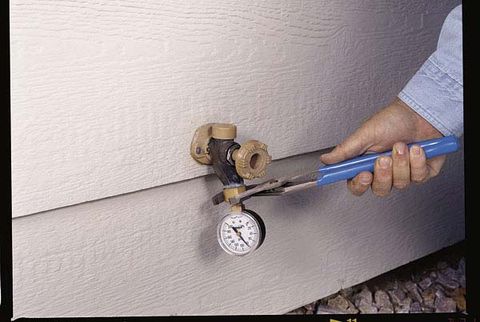
Check the H2o Pressure level
It's of import to kickoff determine the water pressure at an outdoor faucet, using a simple pressure gauge. So, use a 5-gallon bucket to measure how much water your dwelling's plumbing delivers in one minute. Send the water pressure level information to the sprinkler manufacturer you have chosen, along with a sketch of your property, including all critical dimensions.
In return, you'll receive a system layout and a list of all the sprinkler parts you lot'll demand, including those not sold by the manufacturer, simply available at most hardware stores. For this installation, we used Rain Bird, a company that's been designing and manufacturing irrigation products since the early 1930s. The organisation layout they provided divided our lawn into zones, each controlled by a zone valve. In this case, to ensure total coverage, at that place were eight zones and 48 sprinkler heads. The price: $ane,500.
In warmer climates, you can apply PVC pipe to supply h2o to the sprinkler heads. Here, we used polyethylene pipe, which is more flexible and able to withstand freeze-thaw cycles. Consult the local edifice department to see if you lot need a building permit to install a sprinkler system.
The hardest function of installing a DIY sprinkler system is laying all the underground water-supply piping. That is, if you dig the trenches by hand. Opting for the quicker, easier road, nosotros rented a pipe-pulling machine for $180 a 24-hour interval, which saved an immeasurable amount of time and toil.
Nosotros too bought some cocky-tapping saddles, which provide the quickest way to tap into the polyethylene pipe without having to cut or drill the pipe. Just push the saddle downwards onto the pipe at each sprinkler head location, then twist the handle to puncture the pipage, so water tin can period to the sprinkler.
Finally, every sprinkler arrangement needs a backflow preventer to proceed the sprinkler organisation from contaminating the dwelling's potable water supply. A standard, surface-level backflow preventer volition work, but information technology must be placed 12 in. to a higher place the highest point of the k. Here, we installed a reduced-force per unit area backflow preventer and installed it in the basement where the arrangement will be drained each wintertime.
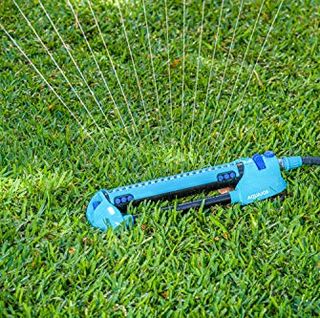
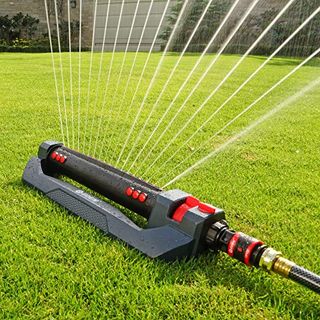
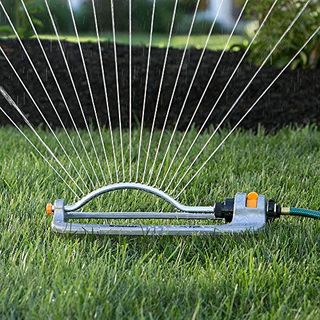
Superlative Rated Sprinklers
Running the Pipes
If digging the trenches past hand, dig the main h2o-supply lines beginning, followed past the shorter branch lines. The trenches should be at least half-dozen in. deep, but 8 to 10 in. deep will give you more room to work.
If yous've rented a pipe puller, brainstorm by attaching the cease of the polyethylene piping to the machine's blade. When running a main line, it's all-time to wrap the low-voltage electric cable around the pipe and pull both at the same time. With the pipage connected, start the motorcar moving forward and lower the blade into the ground.
Adjacent, drill through your home's rim joist, and run copper pipe and electrical cable through the hole and to the basis. Make the conversion from copper to PVC at ground level with a threaded connector. Run the principal PVC line, along with the cable, to the first zone-valve location. Assemble the zone valve higher up basis, and and then cement them to the underground piping.
Install a plastic, inline drain fitting on the downstream side of each valve and connect the cablevision wires. Our cable had 10 wires and each zone valve had two lead wires. Connect one of each pair of valve lead wires to the white common wire, which will service all of the valves. Join a dissimilar color-coded wire to the other lead of each zone valve. Continue making connections in this fashion until you've reached the last valve. With all the valves connected and wired, install the valve boxes then backfill the trenches.
The feed line needs a drain installed at its lowest bespeak. Thread a brass drain plumbing fixtures into the threaded end of a PVC tee and install the tee downward at 45 degrees. Dig a small-scale depression under the bleed, and make full information technology with sand and gravel.
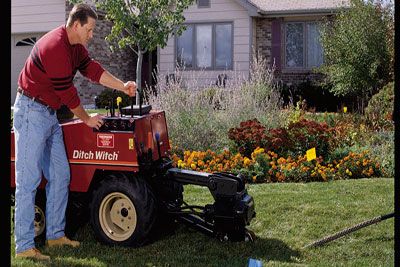
Starting time the pipe puller moving forrad and settle the blade into the turf. The blade will shimmy the pipe down into the ground.
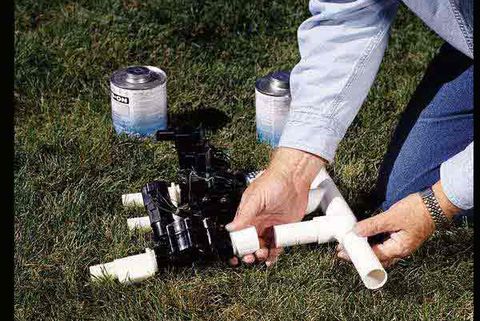
Get together the zone valves above ground, and so connect them to the surreptitious pipes. Install a drain plumbing equipment to each valve.
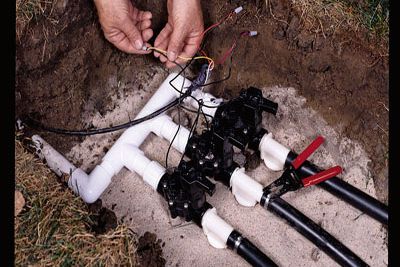
Adhere one of every valve's lead wires to the white common wire and connect a colored wire to each remaining pb.
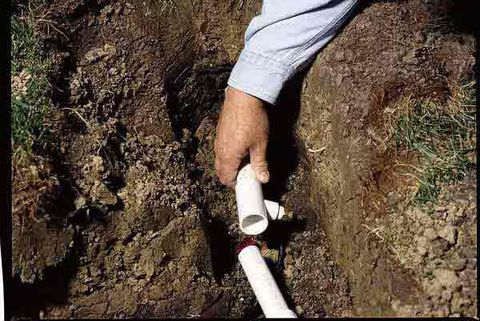
Install a brass bleed valve at each depression spot of the feed line. Thread the valve into the tee with Teflon tape.
To tunnel under walkways, adhere a pointed sluice nozzle to a length of PVC pipage. Connect a hose fitting to the opposite end of the piping, then dig shallow trenches on either side of the walkway. Connect a garden hose to the pipe, turn the water on high and push the nozzle under the walkway to blast a pigsty clear through to the other side.
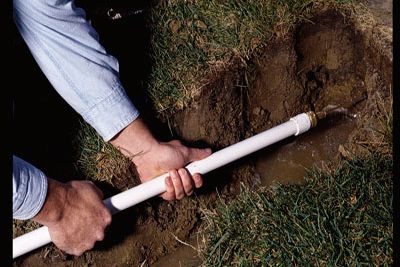
Use a sluice pipe to tunnel under sidewalks. The contumely plumbing fixtures is sold at hardware stores and dwelling centers.
Polyethylene piping is joined together with affront fittings, which tin can be secured with common hose clamps, but stainless steel crimp rings are easier to install. Sever the pipe with a scissors-way tubing cutter, then slide the rings onto the piping and crimp each ane with pliers.
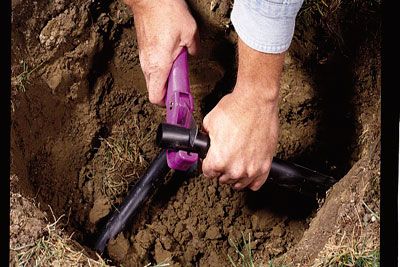
Use a scissors-type tubing cutter to piece polyethylene pipe. It's quick and piece of cake to use, and leaves a clean edge. Slide the crimp band onto each pipe and insert the barb fitting.
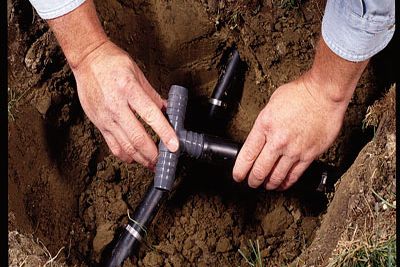
Slide a crimp ring onto each pipage and insert the barb fitting. Slide on the rings and crimp them tight with pliers.
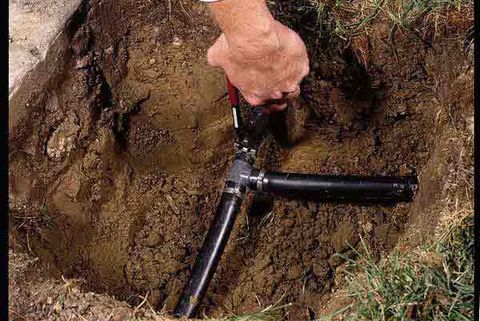
Depict the crimp rings together with crimp-ring pliers.
Installing the Heads
The sprinkler heads can exist continued to the pipes in several ways. If drainage isn't an issue, install a xc-caste elbow with a barb fitting on one end and a female thread on the other.
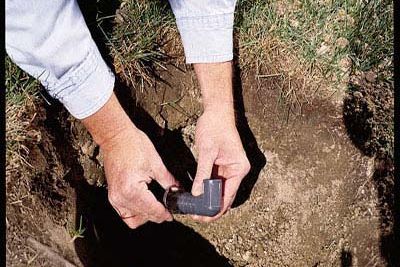
If drainage isn't required, use a ninety-degree elbow at the sprinkler caput. Thread a riser into the top of the elbow. If the sprinkler head is located in a low spot on the property, and needs to exist drained occasionally, and then install a 90-degree drain elbow instead
If you're at a low spot and need seasonal drainage, install a xc-caste drain ell instead.
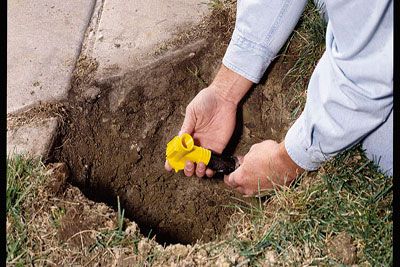
To drain a low spot under a sprinkler head, apply a xc-degree bleed elbow. Exist certain to position it upright with the threads at the tiptop.
Now, connect a sprinkler caput to the elbow with a threaded riser, or make an start swing pipe. To make a swing-pipe connection, thread one 90-degree elbow into the drain fitting and another into the lesser of a sprinkler caput. Use Teflon record on the threads. Then, join the ii elbows with a length of three/8-in. polyethylene swing pipe.

Connect the elbow to the sprinkler head with iii/8-in. swing pipe. Use Teflon record, but no crimp rings. The fit is so snug that it doesn't need a crimp ring. End by backfilling the hole while tamping downward the soil every 4 in.
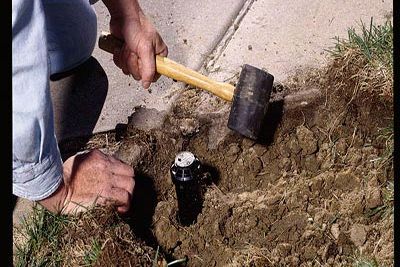
Backfill the hole four in. at a fourth dimension and tamp the soil with a safety mallet. Then tiptop the bare soil with sod or grass seed.
When tapping into a continuous piping run, utilize the self-tapping saddle valve mentioned before.

Press the saddle valve's collar around the pipe and snap it together. You will experience information technology click when information technology locks in place. To connect the head, install either a swing pipe or a threaded riser in the peak of the plumbing fixtures
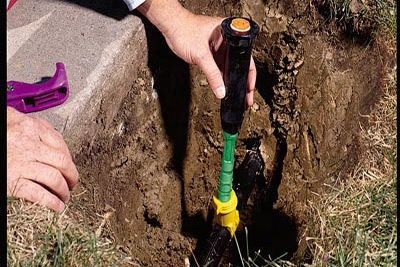
When the pipe is directly nether a sprinkler, connect the head with a threaded riser. We equipped this system with iii types of heads: spray heads for small grassy sections, rotary heads for the larger areas, and a bubbler for the blossom garden. The bubbler sends a trickle of water through 1/8-in. tubing to various spots in the garden.
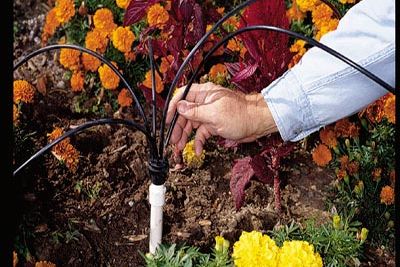
A bubbler head is peculiarly designed to soak a flowerbed without wetting the foliage.
Last Touches
Local plumbing codes will dictate how to tap into your home'due south water system, only the installation shown hither is fairly typical. Cut into the 3/iv-in. water line just across the meter and upsized to one-in. pipe for the sprinkler arrangement. And so, shortly subsequently the tap, install a full-flow ball valve.
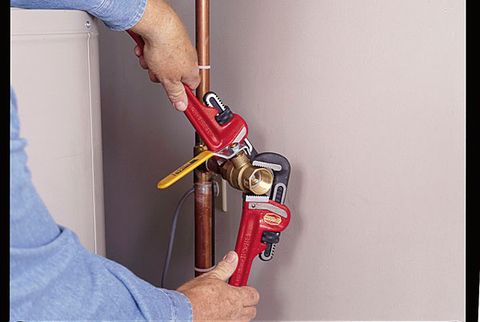
Install a total-flow ball valve so you lot can service the backflow preventer without shutting off the catamenia of water to the unabridged house. Afterward the brawl valve, install a brass nipple and the reduced-pressure backflow preventer. Run piping from the backflow preventer to the piping installed through the rim joist.
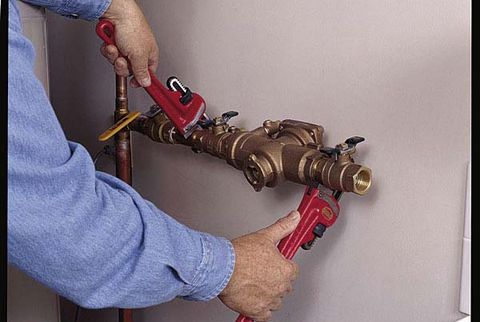
Install the reduced-pressure backflow preventer right after the ball valve. This blazon of preventer will occasionally back surge, so you'll need a catch basin with an air gap underneath it. Pipe the catch bowl to a nearby floor drain with 1-in. pipe. You'll also demand a drain valve in order to drain the overhead line in winter.
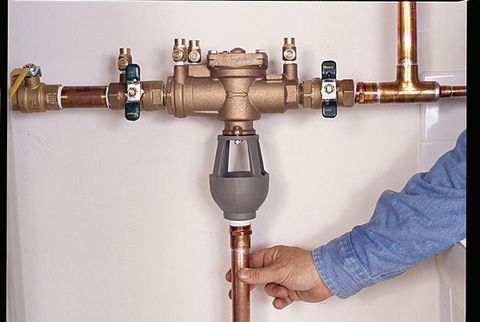
Install an air-gap catch basin on the unit and run a full-size drainpipe to the nearest floor bleed. Mountain the command panel to a nearby wall. Run the cablevision into the panel, strip the wires and connect them co-ordinate to the manufacturer'due south instructions.
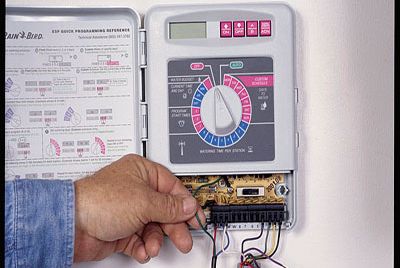
Run the zone-valve cablevision to the control box. Connect the wires according to the installation instructions.
This content is created and maintained by a third party, and imported onto this page to aid users provide their email addresses. You may be able to discover more information about this and like content at piano.io

Source: https://www.popularmechanics.com/home/lawn-garden/how-to/a724/install-sprinkler-system-underground/
Posted by: wilsonplecithince1963.blogspot.com
0 Response to "How To Install New Sprinkler Zone"
Post a Comment